

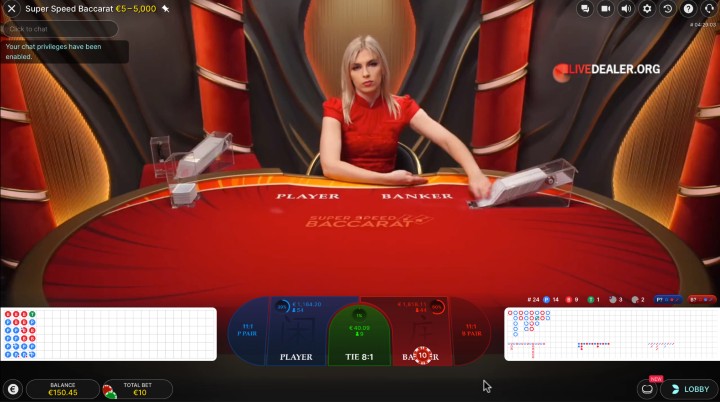
Speed Baccarat takes the familiar structure of traditional baccarat and compresses it into much shorter rounds, which naturally attracts players who want to complete more hands and clear wagering requirements in less time. Yet the faster pace changes not only how many bets can be placed per hour but also how quickly variance and bankroll swings are realized, which matters a great deal to anyone trying to “grind through” turnover conditions. Understanding this balance between pace, risk, and bonus rules is the key to using fast rounds as a tool rather than treating them as a shortcut.
Why Speed Baccarat Appeals to Turnover-Focused Players
Speed Baccarat uses the same basic rules and card values as standard baccarat, but rounds are compressed to around 27 seconds compared with roughly 45–50 seconds or more in regular live games. Because each hand resolves faster, players can fit significantly more decisions into the same session, which is attractive when a bonus requires a specific amount of total betting volume before funds can be withdrawn. For a player who views each hand as progress toward a wagering target, the game’s tempo becomes a practical parameter rather than just a source of excitement.
How Game Speed Translates Into More Rounds
In traditional live baccarat, table procedures, card handling, and player “squeezing” tend to limit the game to about 40–55 resolved hands per hour depending on style and table conditions. Speed Baccarat cuts out many of these slower rituals, dealing cards face-up and moving quickly through betting, dealing, and settlement, which can roughly double the rounds completed per hour in some live-dealer implementations. The increase does not come from rule changes but from trimming seconds from each step of the hand, which cumulatively adds many extra decisions across a multi-hour session.
Simple Comparison: Standard vs Speed Rounds per Hour
| Game format | Approx. rounds per hour | Key pacing factor |
| Standard live baccarat | ~40–55 hands/hour | Slower dealing, squeezing, longer bet windows |
| Speed Baccarat (live) | ~27-second rounds → materially more decisions/hour | Face-up dealing, shorter result time, tighter flow |
This difference in tempo means a player using a fixed unit size reaches any given cumulative bet total much sooner in the faster variant than at a traditional table, assuming constant stake sizing. However, the same acceleration that helps with turnover also amplifies how quickly a player experiences variance, making poor bankroll planning more punishing in practice.
Wagering Requirements and the Logic of Fast Rounds
A wagering or turnover requirement specifies how many times a player must bet the value of a deposit and/or bonus before withdrawals are allowed, often expressed as a multiple like 5x or 10x. For example, a bonus with a 10x wagering condition on a 200-unit combined deposit and bonus demands 2,000 units in total bets before the balance can be cashed out, regardless of short-term wins or losses along the way. In that framework, Speed Baccarat’s value lies in its ability to help a disciplined player reach that cumulative bet figure more quickly, as long as stakes are kept proportionate to bankroll and the underlying house edge remains unchanged.
Bankroll Management in High-Pace Baccarat
From a bankroll management perspective, hundreds of rapid hands increase both the opportunities to gain and the likelihood of encountering extended downswings, even though each individual bet still faces a relatively low house edge compared with many other casino games. Because Speed Baccarat condenses this experience into a shorter time window, bet sizing relative to bankroll—such as keeping units in the 0.5–1% range—becomes more critical to avoid exhausting funds before the wagering requirement is met. For players using the game mainly to “convert” a bonus into withdrawable funds, the key is to treat each hand as one small step in a long sequence rather than chasing short-term streaks that can destabilize the entire plan.
- Core bankroll considerations in fast baccarat
- Unit size must be small enough to survive long sequences of outcomes, positive or negative.
- Total required turnover should be calculated in advance, with an estimate of how many hands it implies at the chosen stake.
- Side bets with higher house edge should generally be excluded from a turnover-focused strategy to limit unnecessary expected loss.
- Session length and fatigue should be factored in, because rapid decisions increase the risk of errors and emotional responses.
When these elements are considered together, the faster structure of Speed Baccarat becomes a controllable parameter in a broader money management plan instead of simply a way to “get it over with,” which often leads to overbetting late in the session.
Strategic Implications of Classic Baccarat Rules in a Fast Format
Speed Baccarat retains the standard rule set where players bet on the Player, Banker, or Tie outcome, with card totals calculated modulo 10 and drawing governed by a fixed third-card tableau. Because nothing in the rules improves the player’s mathematical position, the usual strategic recommendations still apply: many guides emphasize the Banker bet due to its slightly better probabilities, while treating Tie and various side bets as more volatile options with less favorable expectation. The fast structure therefore changes the rhythm, not the underlying mathematics, which is why a player focused on turnover must still prioritize low-edge bets over visually attractive high-payout options.
When Fast Rounds Fail to Help Turnover Goals
The supposed advantage of Speed Baccarat collapses under several common conditions that directly work against efficient turnover. First, if a bonus or promotion counts baccarat at a reduced rate—for instance, only a fraction of each bet amount contributing to the wagering target—the benefit of playing extra hands per hour becomes far less pronounced. Second, players who respond to losing streaks by increasing stake size or adding high-variance side bets often face an increased expected loss per hand, which can erode bankroll faster than the incremental turnover justifies. In both cases, the raw number of rounds completed becomes irrelevant if the associated conditions and behaviors are misaligned with the original goal of preserving capital while meeting wagering milestones.
Interpreting Speed Baccarat Within the Broader casino online Ecosystem
In practical terms, many real-money gamblers encounter Speed Baccarat when browsing the live-dealer section of an internet gambling offering that hosts a mix of table games, slots, and promotional bonuses, even though the focus of their session might be solely on clearing wagering. In such an environment, the fast rounds represent just one of many available formats, and their usefulness depends on how that particular casino online applies contribution percentages, table limits, time-limited promotions, and game-specific restrictions around bonus use. Evaluating where Speed Baccarat fits into that wider catalogue of games requires not only understanding its rules and tempo but also comparing how its turnover efficiency and volatility profile stack up against alternatives like non-live baccarat or other low-edge table games.
Practical Role of Speed Baccarat in Turnover-Oriented Play on UFABET
In some betting environments, a player may prioritize live-dealer card games as the backbone of a measured, turnover-oriented plan and reserve more volatile titles for discretionary play after any wagering obligations have been met. Within that kind of structure, the presence of Speed Baccarat among the live-table options can serve as a practical tool, because the condensed hand length allows a disciplined bettor to steadily accumulate qualifying bets while monitoring bankroll and emotional state across the session; in this context, UFABET becomes one example of an online betting site where users might treat the fast baccarat tables as a controlled, repeatable step in fulfilling bonus requirements and then shift their focus once those conditions are satisfied.
Summary
Speed Baccarat’s main contribution for players focused on “collecting rounds” is its ability to pack many standard baccarat decisions into a short time frame without altering the basic rules or payout structure. The same rapid tempo that helps with meeting wagering turnover also concentrates variance and potential loss, which means the format only truly serves its purpose when paired with conservative unit sizing, awareness of contribution rules, and disciplined avoidance of high-edge side bets. When viewed as one tool within a larger bankroll management plan rather than a shortcut, fast baccarat rounds can support more efficient progress toward wagering goals while keeping risk at a level that matches the player’s long-term objectives.
