

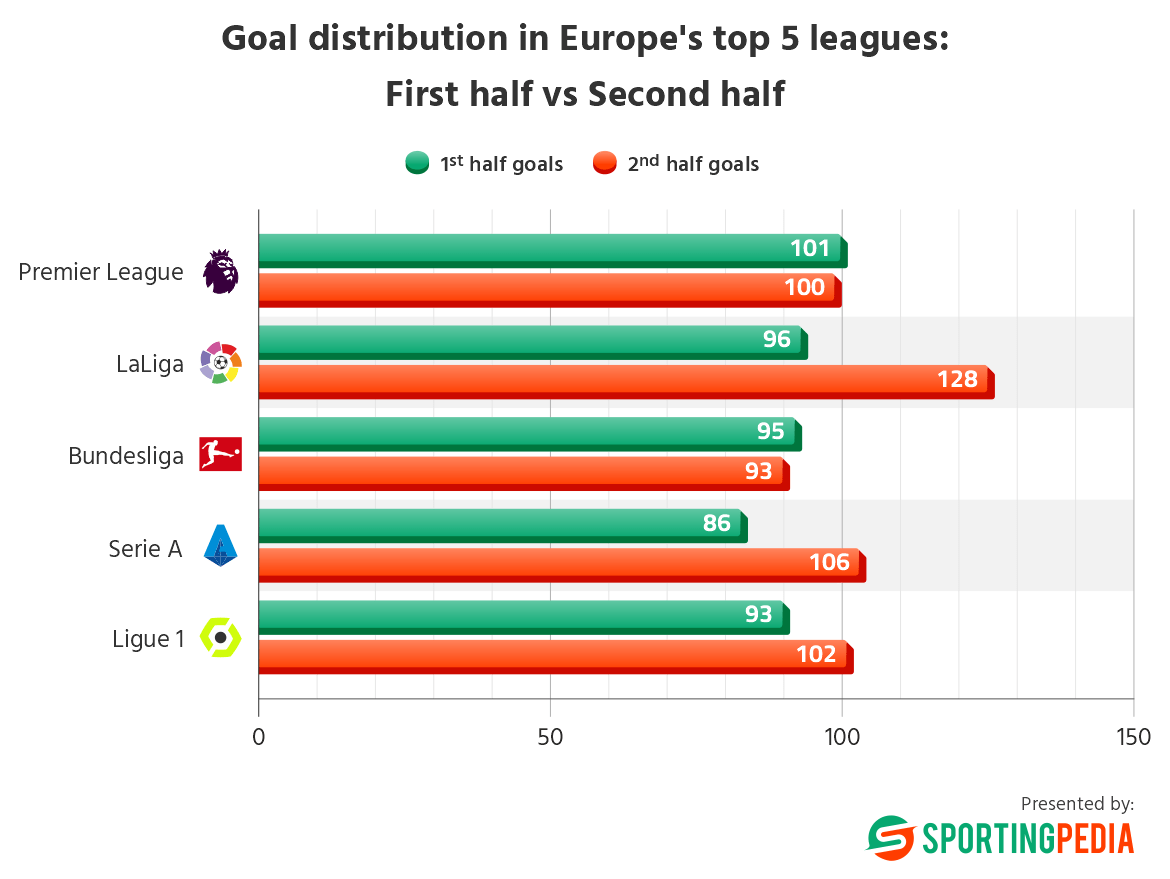
Across recent Premier League seasons, the 45–60 minute window has consistently produced a large share of goals, with league‑wide timing tables showing a clear spike in scoring immediately after the restart. Some clubs stand out inside that segment, repeatedly scoring early in the second half because of how they reset at half‑time, adjust tactically, and manage intensity as opponents mentally and physically switch back on.
Why the Early Second-Half Window Deserves Its Own Focus
Goal‑time statistics for the Premier League break matches into 15‑minute intervals and show noticeable variation in scoring frequency across them. In one recent sample, only 11.5 percent of goals came in the opening 15 minutes, 19.2 percent arrived between 31–45, but a league‑leading 21.8 percent were scored in the 46–60 slot, underlining that the start of the second half is a structurally busy phase.
This matters because the early second half is where half‑time adjustments, fitness margins and psychological swings show up quickly: sides that restart sharply can overturn deficits or extend narrow leads before opponents fully adapt. For analysis, treating that window as its own micro‑phase—rather than just “part of the second half”—helps explain why some teams consistently shift matches in their favour right after the break.
Which Premier League Sides Consistently Threaten After the Restart
Team‑level goal‑by‑half data reveal which clubs heavily weight their scoring toward the second half in general, a necessary first step before zooming into the 45–60 band. In one Premier League breakdown, Liverpool scored 75 percent of their goals in the second half, while Manchester United and West Ham also recorded 75 percent second‑half shares, indicating strong post‑interval production compared with their first‑half output.
Further analytic features highlight Liverpool among the sides with the most pronounced tendency to score after half‑time, with Opta‑based work describing them as substantially stronger in later phases across several seasons. While public stats often group 46–60 with the broader “second‑half” category, the combination of high second‑half shares and league timing curves supports the view that heavyweight pressing teams—Liverpool, City, and others in various years—regularly exploit the immediate post‑break window.
Tactical Reasons Big Clubs Strike Early in the Second Half
High‑intensity Premier League teams build their game around pressing, repeated sprints and sustained attacking, which creates a natural dynamic around half‑time. During the break, coaches review first‑half patterns, adjust pressing triggers and refine build‑up routes, then send players out with clear instructions for the first 10–15 minutes of the restart while legs are still relatively fresh.
Opponents, especially those who spent most of the first half defending, can be slower to re‑establish compactness and concentration, leading to brief lapses in tracking, duels and second‑ball reactions. Big clubs with deep benches and well‑rehearsed patterns are uniquely positioned to exploit those fragile minutes, turning marginal first‑half xG superiority into immediate second‑half goals.
Mechanism: From Half-Time Adjustments to 46–60 Minute Goals
The core mechanism behind early second‑half scoring often follows a simple chain. First, analytics staff identify spaces or match‑ups that looked promising in the first half but were not fully exploited; second, the manager refocuses attacking patterns on those weaknesses at half‑time; third, the team executes more aggressively straight after the restart before the opponent adapts.
Goal‑time tables then record the effect: a disproportionate number of a team’s goals cluster soon after half‑time compared with league averages. Across multiple seasons, narratives around Liverpool and other top sides finishing strongly are supported by such distributions, with the early second‑half spike acting as a transitional phase on the way to the league‑wide late‑goal surge after 76 minutes.
Table: Team Profiles and Their Early Second-Half Goal Patterns
To make these ideas usable when looking at current Premier League data, it helps to group clubs by how their goals distribute between halves and around the restart. The following table outlines broad patterns you can map onto real teams using publicly available goal‑time and half‑split stats.
| Team profile type | Typical goal-timing pattern | Likely 46–60 minute behaviour |
| Second-half specialists | High share of goals after half-time, strong conditioning and deep benches | Frequent early second-half goals, strong ability to flip or extend games right after the break |
| Balanced scorers | Similar goal shares in both halves, steady xG across 90 minutes | Some 46–60 goals, but no big spike; impact depends more on game state than on timing identity |
| Fast starters, fading finishers | Above-average first-half scoring, flatter or weaker late output | Less pronounced threat after the restart; risk of conceding in 46–60 as intensity drops |
Sorting current clubs into these categories using available timing tables shows why certain fixtures feel “live” straight after half‑time, while others drift until late phases. It also clarifies why some sides regularly rescue or inflate scorelines between 46 and 60 minutes while others rarely alter the trajectory in that slot.
List: Practical Indicators That a Team Is Dangerous Just After Half-Time
For pre‑match reading, you need more than a reputation for late goals; you need concrete, repeatable signs that a side consistently threatens early in the second half. The indicators below gain strength as they overlap across seasons and competitions.
- Goal‑time charts show that a clearly above‑average share of the club’s goals arrive in the 46–60 segment compared with league percentages.
- Split‑by‑half stats list the team with a strong second‑half scoring bias, especially when combined with high pressing‑intensity profiles and evidence of fitness advantages.
- Match summaries and data‑driven articles repeatedly reference early second‑half goals as turning points for that club, rather than only very late winners or early blitzes.
When these conditions line up, it is reasonable to describe the team as structurally dangerous just after half‑time, rather than as occasionally lucky in that window. That framing is more useful because it links timing outcomes back to tactical and physical causes.
How to Use Early Second-Half Strength in Pre-Match Thinking (UFABET Paragraph Inside)
If you want to make practical use of early second‑half patterns rather than just describing them, the order of your analysis matters. A sensible sequence is to start with league‑wide goal‑time tables, identify sides whose 46–60 scoring share is clearly above the norm, then cross‑check whether that pattern holds across the current and previous seasons, and only afterwards look at how their opponent typically behaves coming out of the break—do they tighten up or sag in that slot? In a scenario where someone later views live or pre‑match information through a sports betting service front‑end provided by an operator such as ติดต่อ ufabet168, this timing‑first view—flagging fixtures where one side is historically sharp after half‑time and the other often concedes or drifts—acts as a conceptual backbone for interpreting second‑half or goal‑timing markets, rather than letting fluctuating prices alone dictate where attention goes.
Why “Best Early Second-Half Team” Is a Moving Target
It is also important to recognise how quickly this label can change. Coaching shifts, tactical tweaks, injuries and small‑sample randomness all alter how goals distribute through the 90 minutes, especially in a league with only 38 matches per season and many confounding factors.
A club that led the league in 46–60 minute goals one year may regress toward the average the next as opponents adapt to their half‑time patterns or as fixture difficulty changes. Conversely, emerging high‑pressing teams can move into the “second‑half specialist” category quickly once their depth and conditioning improve. That volatility is a reminder to treat goal‑timing trends as short‑ to medium‑term patterns, not as permanent identities.
Early Second-Half Scoring in the Context of Overall Timing
League‑wide timing data place the early second half within a broader scoring curve. In the sample cited earlier, 21.8 percent of goals arrived between 46–60 minutes, but the single largest share came between 76–90, where late game state, fatigue and risk‑taking combined for a 29.5 percent slice of all goals.
This context matters: teams that are strong just after half‑time often also feature among the best late‑goal scorers, because both phases reward fitness, depth, and tactical clarity. For analysis, that means seeing 46–60 as an early indicator of how well a side uses adjustments and conditioning across the entire second half, not as an isolated quirk.
Summary
Focusing on Premier League teams that score most early in the second half is reasonable because goal‑timing data show that the 46–60 minute window is disproportionately rich in goals and that certain clubs repeatedly exploit that phase. The most practical pre‑match approach is to connect those timing patterns to tactical style, half‑time routines and physical advantages, then update them season by season, so that expectations about “fast restarts” rest on identifiable mechanisms and current evidence rather than on outdated labels or a few memorable post‑interval goals.
