

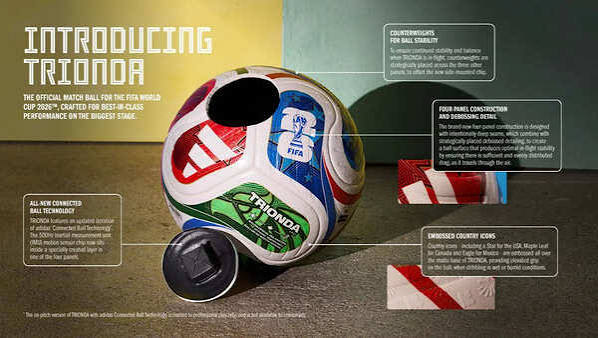
The official ball of the 2026 World Cup, Adidas Trionda, is no longer just leather and air; it is a connected, sensor‑driven device that feeds live data into VAR and semi‑automated systems. That technology shapes how offside calls, handball decisions and even long‑range shots are judged in real time, which changes what matters most for viewers trying to understand what they see on screen.
What exactly is Trionda and how is it built?
Trionda is Adidas’ official match ช่องทางดูบอลสด โกลแดดดี้. for the 2026 World Cup in Canada, Mexico and the USA, introduced in late 2025 as the latest evolution in the long line of World Cup balls. It is built from just four thermally bonded panels—the fewest ever on a World Cup ball—which creates a very smooth outer surface and a highly predictable aerodynamic profile once players get used to it.
This panel layout reduces seam length and helps the ball fly more consistently at high speeds, compared with older 32‑panel designs that could generate more unpredictable movement. For viewers, that means long passes and shots, especially from distance, tend to follow cleaner, more repeatable trajectories, making it easier to judge whether a strike was mishit, deflected or simply beaten by a good save when you watch replays.
How the 500Hz motion sensor works inside the ball
The defining feature of Trionda is its integrated motion sensor, a tiny, rechargeable chip embedded inside one of the panels rather than at the exact centre of the ball. FIFA and Adidas describe it as a 500Hz device, meaning it records the ball’s movement 500 times per second, capturing acceleration, direction changes and precise touch points in three‑dimensional space.
This sensor data is streamed wirelessly in real time to the VAR and semi‑automated offside systems. Every time the ball is struck, headed, glanced or potentially handled, the chip registers a specific “touch” event that can be matched to camera tracking of players. That fusion of ball and player data is what allows officials to pinpoint exactly when a pass begins, whether a defender brushed the ball on its way through, or if contact with an arm actually occurred before a goal.
What you should watch for when it affects offsides and handballs
Because Trionda is linked into semi‑automated offside technology, the ball’s sensor is often the element that defines the “kick point”—the frame where a pass is officially considered to have been played. FIFA’s 2022 explainer on the earlier version of this tech showed how ball data at 500Hz is combined with limb‑tracking from 12 roof‑mounted cameras; Trionda updates that approach with a side‑mounted chip but the same principle: precise, time‑stamped touch data feeding the AI system.
When you watch replays of tight offsides in 2026, the 3D animations and on‑screen freeze frames you see are built from this sensor timeline. The key for live viewing is that the “frame” VAR picks is not chosen by eye but by the moment the sensor registers a clear touch. Similarly, in close handball situations where deflections are disputed, you will sometimes see the broadcast reference how “the connected ball confirmed a touch” before a goal is checked or overturned; that statement is rooted in Trionda’s motion data, not just in slow‑motion images.
How ดูบอลสด feels different when every touch is tracked
When you ดูบอลสด or follow live streams, many of the tight decisions that used to provoke long delays now move faster because the ball itself is sending data to the VAR room. FIFA communications around the 2026 tech push emphasise that the goal is quicker, more accurate decisions on offsides and contact incidents by combining Trionda’s sensor with upgraded AI and 3D visualisation tools for fans.
For viewers, this changes how you interpret the rhythm of stoppages. When play halts for an offside review, the delay is now more about confirming the automatically generated decision than about constructing the whole incident manually. Over multiple matches, you can expect a more consistent pattern: brief pauses followed by graphics that show ball contact, offside line and player avatars in one coherent package, all driven by the ball’s data stream.
How Trionda’s tech compares to the 2022 World Cup ball
The idea of a sensor‑equipped ball is not entirely new; Qatar 2022 already used a connected ball that sent 500Hz data to VAR, forming the backbone of the first semi‑automated offside system in a men’s World Cup. The 2026 iteration, however, pushes things further. Reports on Trionda highlight a side‑mounted 500Hz chip with upgraded AI analysis, more robust wireless communication and closer integration with enhanced VAR tools and 3D player avatars.
In practical viewing terms, that means fewer times when semi‑automated systems flag an alert but officials need long manual checks to resolve ambiguity. The ball’s data is now more finely matched to player models and broadcast visualisations, which should make the explanation of decisions clearer for fans: when a goal is overturned for a barely visible deflection or offside, the replay package will increasingly show you not only the line but also an animation of the precise moment the ball was touched, rooted in Trionda’s sensor readings.
Mechanism: from raw ball data to on‑screen offside animations
The mechanism linking Trionda to what you see is a three‑step chain: the sensor logs position and movement 500 times per second; stadium cameras track 29 data points per player at 50Hz; AI fuses these streams to generate an offside or touch timeline, which VAR then validates before the referee is informed. This process, first outlined for 2022 and now refined, produces both the actual decision and the 3D broadcast animation that explains it.
For the viewer, that means that when a replay graphic pauses at a particular frame with lines drawn and player avatars frozen, that frame is anchored in the ball’s own data rather than being a subjective choice. Understanding that chain helps you trust why a marginal call went one way or another even when the naked eye remains unsure.
How the ball’s design and tech interact with shot and pass perception
Beyond officiating, Trionda’s smooth, four‑panel shell and internal construction influence how shots and passes look and feel, both to players and spectators. Lower seam count and stable panel geometry typically produce more stable flight for driven passes and long shots, while still allowing some curvature and dip when struck with specific techniques—traits that ball engineers and journalists have reported for this generation of designs.
For match analysis, this matters because it reduces the “ball randomness” factor in your interpretation. When a free‑kick moves late or a cross swerves unexpectedly, you can increasingly attribute that to the player’s technique, contact and spin rather than to erratic panel behaviour. Combined with the sensor, which can capture the exact timing and speed of the strike, this makes it easier to judge finishing quality and ball-striking when you watch slow‑motion replays of key chances.
How Trionda is managed during a match
Because the ball contains active electronics, it does not just need to be pumped—it needs to be charged. Coverage of the 2026 tournament notes that each ball’s sensor runs on a rechargeable battery and that multiple Trionda balls (typically between 15 and 20) are prepared and charged before each game, with each unit capable of handling several hours of in‑play use.
On the pitch, you will occasionally see referees or fourth officials swap balls more systematically than before, particularly if a match uses a strict rotation of pre‑checked, fully charged balls. While these changes rarely impact play quality directly, they underscore how deeply the ball is now integrated into the officiating infrastructure: any failure in its sensor would affect VAR timelines, so stadium crews treat each Trionda as both a piece of equipment and a data source.
Summary
The Adidas Trionda, official ball of the 2026 World Cup, combines a four‑panel aerodynamic shell with a 500Hz motion sensor that streams live data into VAR and semi‑automated offside systems. For viewers, that means tighter, faster decisions on offsides, handballs and deflections—and a clearer link between what you see in 3D replays and the ball’s own movement—while also making long passes and shots more predictable and analysable as you watch full matches across the tournament.
