

In industries where a single spark can be catastrophic, how you cut matters as much as what you cut. Refineries, chemical plants, offshore platforms and storage facilities all deal with flammable vapours, pressurised lines and tight shutdown windows. Traditional hot work such as torch cutting or grinding brings ignition risk, permits and heat damage to the surrounding material. That is why many operators now rely on cold cutting, a process that separates steel, concrete and composites without generating heat or sparks.
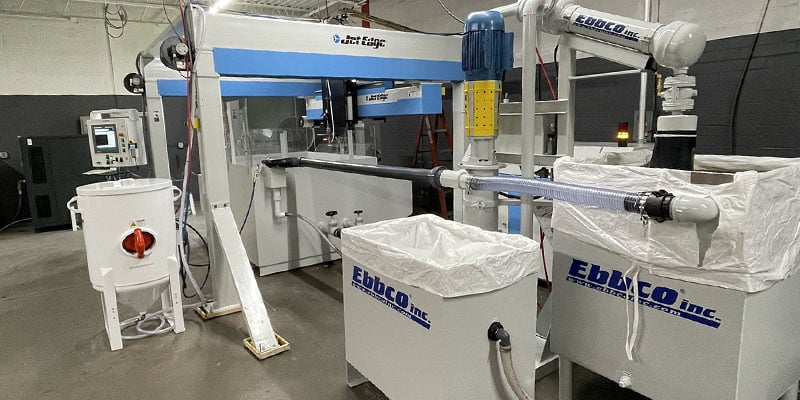
So what does the setup actually look like? Modern cold cutting equipment built around ultra-high-pressure (UHP) water and garnet abrasive combines several specialised components working as one system. Each piece plays a role in cut quality, speed and safety, so understanding them helps asset owners and project managers judge what a contractor brings to site. You can see an example of how a complete service is delivered on cold cutting equipment.
How Water-and-Garnet Cutting Works
The principle is simple. Water is pressurised to extreme levels, often between 40,000 and 60,000 psi (roughly 2,800 to 4,100 bar), and forced through a tiny orifice. This creates a fine, supersonic jet. On its own, that jet can cut soft materials. To slice through steel, thick-walled pipe or reinforced concrete, abrasive garnet is introduced into the stream. The garnet particles do the cutting, while the water accelerates them and carries away debris.
Because the material is eroded rather than melted, there is no heat-affected zone, no warping and no ignition source. That makes the method well suited to live or recently live facilities, confined spaces and hazardous atmospheres.
The Core Equipment Components
1. UHP Pump Unit
The pump is the heart of the system. Typically diesel-driven for remote sites, it generates the pressure needed for abrasive cutting. Most units are skid- or trailer-mounted, so they can be positioned at a safe distance from the work area. Good pumps offer consistent pressure, since fluctuations directly affect cut quality, and they include built-in safety features such as pressure relief and emergency stops.
2. High-Pressure Hoses and Fittings
Specialised UHP hoses and couplings carry pressurised water from the pump to the cutting tool. These are rated well above operating pressure and are inspected, tested and tagged regularly. Hose management is a significant part of site safety, including proper routing, whip restraints and clear exclusion zones.
3. Abrasive Delivery System
Garnet is stored in a hopper or pressurised pot and metered into the water stream at a controlled rate. Getting the flow right matters: too little garnet slows the cut, while too much wastes material and can reduce efficiency. Garnet is used because it is hard, angular, chemically inert and non-toxic, which makes it safer and cleaner than many alternatives.
4. Cutting Head and Nozzle Assembly
The cutting head is where water and abrasive meet. It typically includes an orifice, a mixing chamber and a focusing nozzle that shapes the stream. These parts wear over time and are replaced routinely to maintain accuracy. Head design varies depending on whether the job involves pipe severing, tank wall openings, flange removal or concrete cutting.
5. Remote-Controlled Cutting Tools
For precision and operator safety, cutting heads are usually mounted on tools that can be operated remotely. Depending on the job, these may include pipe-cutting rigs that clamp around a line and travel 360 degrees, guide rails for straight cuts on plate or vessel walls, and robotic or crawler systems for larger surfaces. Remote operation keeps personnel out of the direct line of the jet and away from potentially hazardous areas.
6. Containment and Catchment Equipment
Spent garnet and water need to go somewhere. Shrouds, catch trays, vacuum units and containment barriers capture the slurry so it does not spread through the work area. On environmentally sensitive sites, this is just as important as the cut itself, and it keeps clean-up time down after the job.
Safety Systems That Go With the Equipment
Hardware alone is not enough. A properly run cold cutting operation includes dump valves and deadman controls so pressure can be released instantly, barricading and exclusion zones around the jet path, and operators trained and certified in UHP work. Pre-job inspections and pressure testing confirm that every component is fit for duty before anything is cut.
Why the Right Equipment Matters
The quality of the equipment directly affects the outcome of the job. Stable pressure, well-maintained nozzles and accurate positioning tools produce cleaner cuts, less rework and shorter downtime. For facilities where every hour of shutdown is costly, that efficiency adds up quickly.
It also affects compliance. Because cold cutting avoids hot work permits in many scenarios, it can simplify planning and reduce the risk profile of a project. But that advantage only holds when the equipment is correctly specified, operated and maintained.
Final Thoughts
Cold cutting is more than a safer alternative to torches and saws. It is a carefully engineered system of pumps, hoses, abrasive delivery, cutting heads, remote tooling and containment, all designed to work together at extreme pressure. When you are choosing a contractor or planning a shutdown, ask what equipment they use, how it is maintained and what safety controls are built in. Those answers will tell you a lot about how smoothly, and how safely, the job will go.
